
Amazon listing optimization: Strategic Framework for Long-Term Growth
Key Takeaways
Amazon listing optimization works best as a connected commercial system rather than a one-time copy edit. The strongest listings make the product easy to find, understand, trust, and buy.
- Start with the customer, use case, and competitive position before choosing keywords.
- Build search visibility around relevant, high-intent language rather than keyword volume alone.
- Make every title, bullet, image, and description answer a real buying question.
- Reduce returns and hesitation by setting precise expectations about the product.
- Improve through controlled testing, commercial metrics, and regular listing maintenance.
1. Build the strategic foundation for Amazon listing optimization
A listing is not an isolated marketing asset. It sits between a shopper’s problem and a business’s profit target, so its content must reflect both sides of that decision. Before changing a title or image, establish who the product is for, why that person is shopping now, and what makes the offer worth its price. This foundation keeps optimization from becoming a sequence of disconnected guesses.
Define the product’s target customer and purchase context
Begin with the customer’s situation, not a broad demographic label. A parent buying a travel bottle, for example, may care about leak prevention, cleaning time, and fit in a bag, while a gift buyer may care more about presentation and certainty. Record the moment that prompts the search, the alternatives under consideration, and the practical conditions in which the product will be used.
That context gives the listing a sharper point of view. It also helps separate urgent purchase questions from background information that can wait until later on the page.
Map customer problems to listing promises
Translate each meaningful customer problem into a promise the product can honestly support. The promise should connect a feature to a useful outcome, such as a material choice leading to easier cleaning or a design detail making storage simpler. Avoid claims that sound impressive but cannot be verified through the product, packaging, or customer experience.
A simple message map can keep the copy disciplined: problem, product response, evidence, and expected result. This approach is useful when reviewing Blue Amber Digital, whose published service description includes comprehensive listing optimization; the same principle applies whether the work is done internally or with an agency.
Analyze competitors without copying their positioning
Competitor research should reveal category expectations and gaps, not encourage imitation. Note recurring claims, image conventions, price bands, review complaints, and questions shoppers repeatedly ask. Then decide which expectations your product meets, exceeds, or should clearly avoid promising.
The useful question is not “What words are they using?” It is “What decision have they made easier, and where does their page leave uncertainty?” A distinct position can come from a narrower use case, clearer proof, better compatibility information, or a more credible price-to-value explanation.
Align the listing with brand differentiation and pricing strategy
The page should make the price feel understandable. If the offer is premium, explain the construction, durability, service, or included elements that support that position. If the product competes on simplicity or value, remove distractions and show why the core offer is practical.
Amazoniac’s published positioning is grounded in seller experience and full-ownership account management, including SEO, PPC, and operational oversight. That perspective is a useful reminder that listing decisions should connect to inventory, advertising, and profitability rather than being judged only by how polished the page looks.
2. Develop a search and keyword strategy
Search terms are the language bridge between customer intent and product relevance. Strong keyword work does not mean placing every possible phrase into visible copy; it means identifying what shoppers mean, how close they are to purchase, and which terms genuinely describe the product. Treat search as a commercial input to the listing, not as a separate technical exercise.

Identify high-intent keywords across the buying journey
Start with broad category language, then move toward terms that reveal use case, material, compatibility, size, or urgency. A general phrase may bring discovery traffic, while a more specific phrase can signal a shopper who already knows what they need. Both have value, but they should not carry the same priority.
Review search behavior alongside conversion evidence and sales velocity. A keyword research framework can help organize comparative, seasonal, and purchase-intent terms without treating search volume as the only measure of opportunity.
Separate primary, secondary, and backend search terms
Primary terms belong where shoppers should immediately see the product’s identity and relevance, usually in the title and leading bullets. Secondary terms can support use cases, attributes, and related language in the remaining copy. Backend terms are useful for relevant variations that would make visible writing awkward, but they should never be used to disguise an unrelated product.
This separation also makes future edits easier. When performance changes, you can see whether the problem is core relevance, missing context, or an overly ambitious term list rather than rewriting the entire page at once.
Use customer language from reviews, questions, and support data
Customers often provide better wording than a formal keyword list. Reviews reveal the phrases people use after ownership, while questions expose uncertainty before purchase. Support tickets add another layer by showing where product instructions, compatibility, or expectations are unclear.
Collect these terms in groups: desired outcomes, frustrations, objections, and practical descriptors. Their value is not just search coverage. They help the listing sound like a response to a real shopper instead of a catalogue of manufacturer language.
Balance search visibility with natural, persuasive copy
A keyword is useful only when it remains relevant and readable. Repeating a phrase until the sentence feels unnatural can reduce confidence, especially when the product category is competitive and shoppers scan quickly. Use close variants where they make sense, then let the surrounding sentence explain the benefit or use case.
A good final review asks whether a customer could describe the product accurately after reading the page once. If the answer is no, more keyword insertion is unlikely to solve the underlying problem.
3. Create conversion-focused listing copy
Copy has one job before the purchase: remove uncertainty. The title establishes what the item is, bullets explain why it matters, and longer-form content gives hesitant shoppers enough detail to proceed. Each element should add information rather than repeat the same claim in a different shape.

Write a title that clarifies relevance and product value
A title should identify the product quickly and put its most decision-relevant attributes in a sensible order. Include the product type, defining feature, intended use, and important variation information where appropriate. Do not bury the basic answer under adjectives or vague brand language.
Read the title aloud and check whether it makes sense without the image. If a shopper still cannot tell what the item is, who it suits, or which version they are viewing, the title needs simplification before it needs additional terms.
Structure bullet points around benefits, use cases, and proof
Bullets work best as a sequence of answers. One may explain the primary benefit, another the use context, another a key specification, and another a limitation or compatibility detail. The strongest bullets pair a customer outcome with the feature that makes it credible.
Use this compact review before publishing:
- Does each bullet cover a different buying question?
- Is the benefit clear before the technical detail?
- Can the claim be confirmed by the product or documentation?
- Does the copy explain who should use the product?
After the review, trim repeated adjectives and replace them with concrete details. Specific evidence builds confidence more reliably than a long list of superlatives.
Use the product description and A+ Content to overcome objections
Longer content should handle questions that do not belong in the title or primary bullets. Explain setup, care, dimensions, comparisons between variants, and the circumstances where the product may not be suitable. A+ Content can give those explanations a more visual structure, particularly when a product has several components or use steps.
The goal is not to make the page longer for its own sake. It is to give a cautious shopper enough context to choose correctly without leaving the listing to search for basic answers elsewhere.
Address compliance, readability, and marketplace requirements
Review every claim against the product and the marketplace rules before publication. Remove unsupported guarantees, medical implications, unverifiable rankings, and language that creates an expectation operations cannot meet. Also check mobile readability, punctuation, variation details, and the consistency between visible copy and product data.
A final compliance pass is part of conversion work, not an administrative afterthought. A technically attractive page can still underperform if it creates confusion or exposes the account to avoidable risk.
4. Design visuals that communicate value quickly
Images often answer the first practical questions before a shopper reads a word. They should show scale, form, use, included parts, and the product’s most meaningful difference in an order that follows the buying decision. Visual polish matters, but clarity matters first.
Plan image order around shopper decision-making
Think of the image stack as a short explanation. Begin with a clean product view, then move through the main benefit, use in context, important specifications, and details that prevent mistakes. The order should reflect the questions a new shopper asks, not the order in which the creative team happened to produce the assets.
Review the stack on a mobile screen and remove any image that repeats another without adding information. A smaller set of purposeful visuals can be more persuasive than a crowded gallery.
Use the main image to establish clarity and click appeal
The main image must make the product recognizable at a small size. Show the correct variation, included components, and proportions without decorative elements that create ambiguity. Click appeal should come from a clear, well-lit product presentation rather than visual noise.
Check the image against the title and selected variation. If the shopper sees one configuration but receives another, the listing has created a preventable trust problem before the detail page is even opened.
Demonstrate product features through infographics and lifestyle images
Infographics can clarify dimensions, materials, steps, and compatibility, while lifestyle images help a shopper imagine the product in a relevant setting. Each visual should carry one main message and use enough contrast and spacing to remain legible on a phone.
Lifestyle scenes should be believable rather than overly staged. They need to show the product in the situation that matters, with the scale and interaction visible enough to support a purchase decision.
Apply video and A+ Content to explain complex products
For products with setup, movement, multiple parts, or a less familiar use case, video can demonstrate what static images cannot. A+ Content can then organize comparisons, process explanations, and supporting details lower on the page. Both formats should answer a question that visible copy alone leaves unresolved.
Keep the sequence consistent across media. If the video, images, and copy describe different configurations or uses, additional content will increase hesitation instead of reducing it.
5. Strengthen trust and reduce purchase friction
Trust is built through agreement between what the shopper sees, what the product page promises, and what arrives at the door. Small ambiguities about dimensions or compatibility can have a large commercial cost when they lead to disappointment, returns, or poor feedback. The listing should therefore be treated as part of the delivery experience.
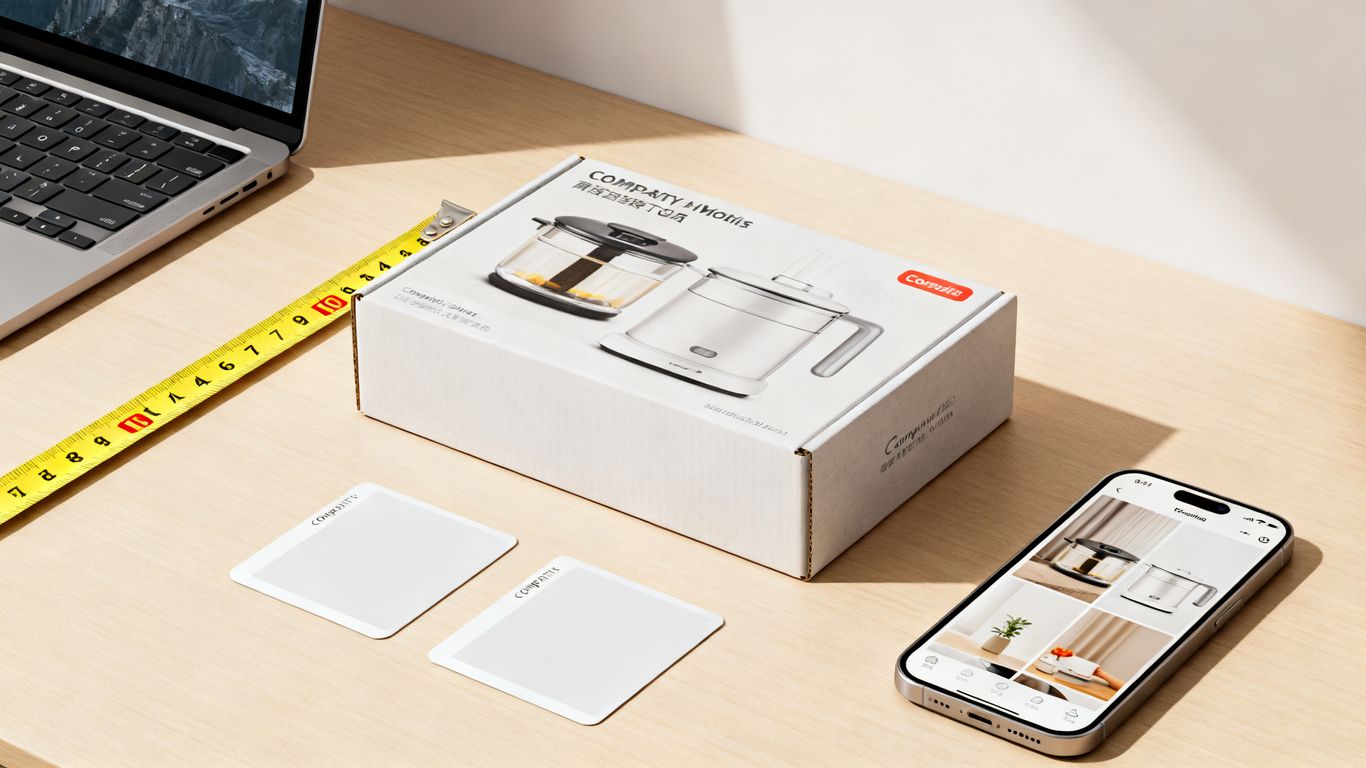
Set accurate expectations about size, compatibility, and usage
Show measurements in familiar contexts and state what is included or excluded. If the product works only with certain models, materials, surfaces, or conditions, say so plainly. Avoid assuming that a technical specification will be interpreted correctly without an example.
The best expectation-setting is easy to find and hard to misread. It may feel less promotional, but it protects the customer’s decision and the account’s long-term performance.
Incorporate reviews and questions into listing improvements
Reviews and questions are a continuous source of editorial direction. Group recurring comments into themes, then decide whether each theme needs a copy change, a new image, better instructions, a product revision, or no response because it reflects an isolated misunderstanding.
Do not treat every negative comment as a reason to promise more. Sometimes the correct improvement is a clearer limitation that helps the right customer choose the product and helps the wrong customer move on.
Prevent avoidable returns through clearer information
Returns often begin with a mismatch between imagined and actual use. Make fit, capacity, texture, assembly, care, and limitations visible before purchase. Where a comparison chart is appropriate, use it to distinguish variants rather than to inflate the page with generic features.
Track return reasons alongside conversion results. A small lift in orders is not a healthy improvement if it comes from a claim that attracts customers who are unlikely to be satisfied.
Coordinate listing claims with packaging, product quality, and fulfillment
Every promise must survive beyond the product page. Check that packaging uses the same names and instructions, that the physical item matches the images, and that fulfillment can consistently deliver the promised configuration. This is where listing optimization becomes operational ownership rather than surface-level editing.
Amazoniac’s full-service model includes account management from setup to FBA shipments, according to its published service information. That kind of cross-functional coordination matters because a listing cannot compensate for a product or fulfillment process that contradicts it.
6. Test and improve the listing systematically
Optimization becomes more reliable when each change has a reason and a measurement window. Avoid changing the title, images, price, and advertising structure at the same time unless a major relaunch requires it. Isolating meaningful variables gives the team a better chance of learning what actually affected performance.
Prioritize changes by potential impact and implementation effort
Rank opportunities by the size of the customer problem, the number of shoppers affected, the likely commercial impact, and the work required. A missing compatibility image may deserve attention before a minor wording preference because it can affect both conversion and returns.
A practical priority order is often clarity first, relevance second, proof third, and refinement last. This keeps limited creative and operational resources focused on changes that can alter the buying decision.
Run controlled tests on copy, images, and A+ Content
Set a clear hypothesis before making a change. For example, replacing a generic feature image with a scale-led use image should improve understanding for shoppers concerned about size. Define the primary metric, hold other major variables steady where possible, and allow enough time for a useful sample.
Amazoniac’s seller-led positioning favors accountability for commercial outcomes, which is a helpful standard for testing: every experiment should have an owner, a reason, and a decision attached to the result. A test that produces no winner can still be valuable if it narrows the next question.
Distinguish seasonal fluctuations from meaningful performance changes
Amazon performance moves with demand, promotions, stock position, competitor activity, and advertising pressure. Compare appropriate periods and account for events that change traffic quality or purchase urgency. A short decline during a demand shift should not automatically trigger a wholesale listing rewrite.
Look for sustained movement across related indicators. A change that appears in conversion, returns, customer questions, and sales quality is more persuasive than a single unusual day.
Document hypotheses, test periods, and winning variations
Keep a change log with the original asset, the hypothesis, launch date, test window, observed result, and decision. Record the context as well, including promotions, stock interruptions, and major campaign changes. This prevents teams from repeating old experiments or mistaking memory for evidence.
Over time, the log becomes a practical operating history. It shows which messages customers understood, which claims caused confusion, and where the listing still needs better evidence.
7. Measure performance and scale long-term growth
A listing should be evaluated as part of a wider account, not through one isolated metric. Search visibility creates opportunity, clicks reveal appeal, conversion shows whether the page closes the gap, and sales velocity reflects the commercial effect over time. Profitability and customer satisfaction keep that growth honest.
Connect impressions, clicks, conversion rate, and sales velocity
Start with the path from exposure to order. Low impressions may indicate relevance, indexing, or demand problems; strong impressions with weak clicks can point to the main image, title, price, or offer; clicks without orders often signal a conversion or trust issue. Sales velocity adds a time dimension, helping distinguish a temporary spike from durable momentum.
Review these measures together rather than celebrating one in isolation. The point is to locate the bottleneck and choose the next action, not to create a larger reporting file.
Track organic ranking alongside advertising performance
Advertising can create visibility and useful search-term evidence, but paid traffic should not be mistaken for organic strength. Monitor where important terms appear organically, how paid placement affects total sales, and whether the listing converts traffic from both sources.
A listing growth blueprint can provide a useful reference for connecting titles, backend terms, conversion, and customer satisfaction to ranking work. The operating question remains commercial: is additional visibility producing profitable demand?
Use profitability, return rate, and customer feedback as guardrails
Revenue growth is only useful when the economics and customer outcome remain sound. Track contribution margin, advertising cost, TACoS, return reasons, review themes, and account health alongside traffic and order measures. These guardrails reveal when a listing is attracting volume at the expense of quality.
Amazoniac’s brand brief places profitability, operational oversight, and account health ahead of vanity metrics. That is the right discipline for deciding whether a successful test should be scaled, revised, or stopped.
Refresh listings as products, competitors, and customer intent evolve
A listing can lose relevance without any obvious error. Products change, new objections appear, seasonal language shifts, competitors improve their presentation, and customer expectations move. Schedule reviews of search terms, images, questions, reviews, returns, and commercial performance rather than waiting for a visible decline.
Refresh with purpose. Preserve elements that continue to work, replace information that has become unclear, and keep the page aligned with the product customers can actually receive.
Conclusion
Amazon listing optimization is a long-term operating practice: understand the customer, make the offer clear, support it with useful visuals and evidence, then improve it through disciplined measurement. When the listing stays aligned with product quality, fulfillment, advertising, and profit, it can support sustainable growth rather than short-lived traffic. If you want an experienced partner to review the system with a seller’s perspective, start a conversation with Amazoniac.
Frequently Asked Questions
What is Amazon listing optimization?
It is the ongoing improvement of a product page’s search relevance, clarity, persuasive content, visuals, trust signals, and commercial performance.
Which part of a listing should be optimized first?
Start with the largest source of customer confusion or lost intent. Usually that means clarifying the product identity, primary use, key benefit, or an important compatibility detail before making minor wording changes.
How many keywords should an Amazon listing include?
There is no universal ideal number. Use the relevant terms needed to describe the product naturally, separating core visible language from useful secondary and backend variations.
How often should an Amazon listing be updated?
Review performance and customer feedback regularly, with a deeper audit after meaningful product, pricing, seasonal, competitive, or fulfillment changes. Update when evidence shows a problem rather than changing content on an arbitrary schedule.
Do better images improve Amazon conversion rate?
They can improve understanding and confidence when they clarify the product, scale, use case, or important feature. Their effect depends on the offer, traffic quality, price, reviews, and the rest of the page.
How should sellers measure listing performance?
Connect impressions, clicks, conversion rate, sales velocity, organic visibility, advertising results, profitability, return reasons, and customer feedback. This combination helps identify both growth opportunities and quality problems.
Can listing optimization reduce product returns?
Clearer information can reduce returns caused by incorrect expectations about size, fit, compatibility, included parts, care, or usage. It cannot replace product quality or reliable fulfillment, so those areas must be reviewed together.