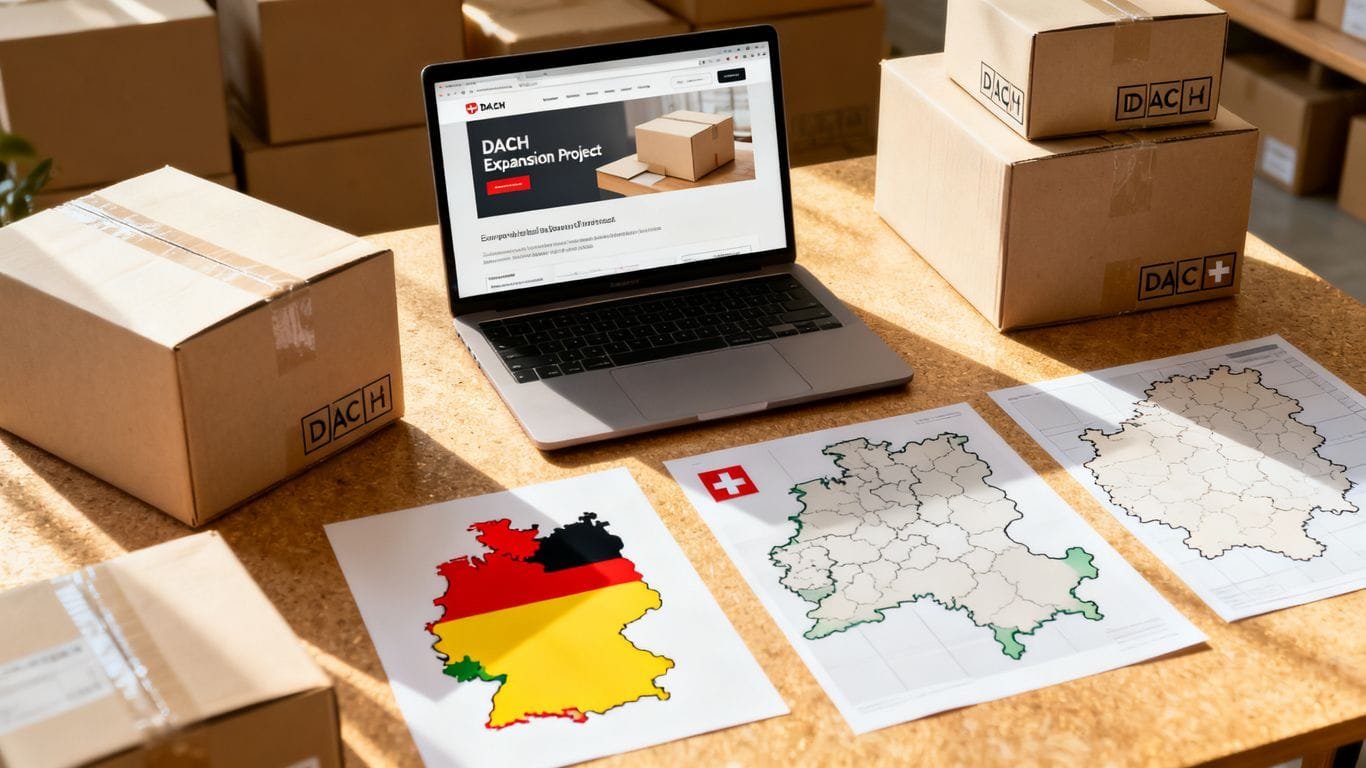
Amazon PPC for DACH market: Practical Framework for 2026
Key Takeaways
A profitable DACH PPC program starts with local market decisions, not copied campaigns from another marketplace.
- Treat Germany, Austria, and Switzerland as related but distinct markets.
- Fix catalog, fulfillment, pricing, VAT, and compliance issues before spending heavily.
- Separate campaigns by marketplace, product line, intent, and commercial objective.
- Judge performance against margin and total business growth, not ACoS alone.
- Scale through disciplined testing, automation with oversight, and regular strategic reviews.
1. Define the DACH market opportunity and PPC objectives
Amazon PPC for DACH market planning requires more than translating an existing media plan. Germany usually deserves the deepest initial analysis, while Austria and Switzerland need their own assumptions for demand, pricing, delivery, and profitability. Start with the commercial realities of each marketplace, then build advertising objectives around what the business can actually supply.
Compare buyer behavior across Germany, Austria, and Switzerland
German-language shoppers share vocabulary, but they do not form one uniform audience. Search habits, price sensitivity, delivery expectations, local competition, and currency considerations can differ across Germany, Austria, and Switzerland. Treat shared language as a starting point for research rather than permission to copy the same bids and budgets everywhere.
Review search-term reports and conversion patterns by marketplace. A term that produces efficient sales in Germany may have too little volume in Austria, while Switzerland may require a different price and margin calculation. Those differences should shape campaign structure before launch.
Set market-specific sales, profit, and visibility goals
Define the result each market must produce over the next quarter. A launch market may prioritize qualified traffic and first sales, whereas an established marketplace may need incremental profit, stronger branded defense, or support for a new product line. The objective should be stated in commercial terms and connected to inventory and contribution margin.
Use separate targets for revenue, advertising-attributed sales, new-customer growth where available, and visibility. Profit comes first when the account has limited stock or a narrow margin, while a controlled launch can justify a different investment profile for a defined period.
Align ACoS, TACoS, ROAS, and contribution margin targets
ACoS helps evaluate advertising spend against ad-attributed sales, but it is not a complete business diagnosis. TACoS adds total revenue to the view, ROAS expresses return on spend, and contribution margin shows what remains after product, fulfillment, marketplace, and advertising costs. Use all four as related lenses rather than chasing one universal benchmark.
Set a break-even ACoS from the actual unit economics of each product and marketplace. Then create operating ranges: an acquisition range for controlled growth, an efficiency range for mature products, and a defensive range for branded demand. These ranges give bid decisions a commercial boundary.
Build a 2026 budget by market, product, and growth stage
Budgeting becomes more useful when it follows demand and product maturity instead of dividing one annual number evenly. Allocate by marketplace, product line, and stage, then review the assumptions whenever inventory, price, conversion rate, or competition changes. A European PPC framework can provide useful context for adapting campaign decisions across countries.
A practical planning grid might look like this:
| Dimension | Launch focus | Growth focus | Mature focus |
|---|---|---|---|
| Marketplace | Validate demand and conversion | Expand efficient reach | Defend and harvest demand |
| Product | Lead SKU or hero offer | Winners and related products | Full profitable range |
| Budget logic | Controlled learning spend | Fund proven opportunities | Protect margin and share |
The grid is not a substitute for a forecast. It is a way to expose where the budget is meant to learn, where it is meant to scale, and where spending should be restrained.
2. Prepare the account, catalog, and localization foundation
PPC cannot compensate for a listing that creates uncertainty or an operation that cannot deliver. Before launch, check the complete path from impression to delivered order: eligibility, detail-page quality, price, stock, fulfillment, returns, and compliance. Localization should make the offer feel native to the shopper, not merely translated word for word.

Check marketplace eligibility, fulfillment, and inventory coverage
Confirm that every advertised ASIN is eligible for the intended marketplace and ad format. Review fulfillment coverage, delivery promises, account health, and available stock before setting aggressive budgets. A campaign that wins clicks while the product goes out of stock can damage both efficiency and momentum.
Create a market-by-market readiness check. Include replenishment lead time, inbound inventory, suppressed listings, stranded inventory, and any restrictions affecting the product category. Advertising should follow operational readiness, not run ahead of it.
Localize titles, bullets, images, A+ Content, and Brand Store pages
German shoppers need clear information about fit, materials, dimensions, compatibility, and use. Rewrite titles and bullets for natural German search behavior, then make sure images and A+ Content support the same promise. The Brand Store should carry that message into browsing and branded discovery.
A translation can be grammatically correct and still miss the language shoppers use. Work from local search research and customer questions, then check whether the final copy sounds natural to a native reader. For a broader foundation, review this guide to Amazon listing optimization before sending traffic to the detail page.
Adapt keyword research to German language structure and search intent
German compounds, inflections, plural forms, and word order can change how a product is found. Build a seed list from local marketplace searches, competitor detail pages, customer language, and category terminology rather than translating an English list mechanically. Keep English terms where the category genuinely uses them, but validate their demand.
Classify terms by intent: problem, product, feature, use case, brand, and competitor. This makes it easier to decide which queries belong in discovery campaigns, which deserve exact-match control, and which should be excluded from a particular product.
Resolve variation, pricing, VAT, and compliance issues before launch
A clean variation family helps shoppers compare legitimate choices without confusion. Check parent-child relationships, pricing consistency, VAT treatment, required product information, and marketplace-specific compliance before ads begin. If the offer or price changes materially between countries, reflect that difference in the forecast rather than hiding it in a blended average.
Run a final pre-launch review with the catalog and operations owners. Advertising teams should know which ASINs are approved, which products are restricted, and what stock or price changes require a budget response.
3. Build a scalable Amazon PPC campaign architecture
A scalable account is easy to read when performance changes. Separate the variables that need different decisions: marketplace, product line, match type, targeting method, and objective. This prevents one campaign from mixing discovery data with branded defense and makes budget movement far more deliberate.

Separate campaigns by marketplace, product line, and objective
Create distinct campaign groups for Germany, Austria, and Switzerland wherever the budget, language, price, or target differs. Within each marketplace, separate hero products from low-margin products and launch activity from mature efficiency work. Naming should make the answer to “what is this spend for?” visible without opening every setting.
A simple structure might use marketplace, ASIN or product family, ad type, targeting mode, and match type in that order. Keep a written naming convention, because consistency matters even more when several people manage the account.
Use Sponsored Products for discovery, conversion, and defense
Sponsored Products can serve different jobs, but each job needs its own control system. Auto campaigns can collect search and product insights, manual campaigns can direct spend toward researched targets, and branded campaigns can help protect demand for the catalog. Do not judge them against the same efficiency expectation when their roles differ.
Move proven search terms into controlled campaigns only after there is enough evidence to make the transfer meaningful. Keep discovery active at a measured level so the account continues to learn as shoppers, competitors, and products change.
Add Sponsored Brands and Sponsored Display at the right growth stage
Sponsored Brands and Sponsored Display should enter when the catalog, Brand Store or detail-page experience, creative assets, and measurement approach can support them. Their role may be broader than immediate product conversion, so define the intended customer journey before allocating material budget. Use formats that match the stage of the brand rather than adding every available option at launch.
The Amazon PPC management guidance is useful when deciding how Sponsored Products, Sponsored Brands, and Sponsored Display fit into a wider performance plan. The principle is simple: add complexity only when the account can interpret and act on the resulting data.
Structure portfolios, naming conventions, and placement controls for reporting
Portfolios should group campaigns according to a management question, such as marketplace, product family, or profit center. Use consistent labels for country, ASIN, objective, and targeting type, and document placement modifiers separately from base bids. This creates clean comparisons without forcing every campaign into an identical structure.
Review the architecture whenever products move from launch to growth or when a market develops enough volume to justify its own controls. An account should become more precise as it grows, not merely larger.
4. Develop a keyword and targeting strategy for DACH shoppers
Targeting should reflect how DACH shoppers describe a need, compare products, and decide whether an offer is credible. Start with local language and marketplace evidence, then broaden carefully into product and audience signals. The goal is not the largest keyword list; it is a useful map of intent that can be funded and measured.
Combine German, English, brand, competitor, and product-use searches
Begin with German product nouns, compounds, features, problems, and use cases. Add English terms only where shoppers and the category use them naturally, then separate branded searches from generic acquisition and competitor terms. Product-use searches often reveal a need that a narrow product-name list misses.
Group terms by intent and expected value. A high-intent exact term may deserve a higher bid than an exploratory use-case phrase, even when both are relevant to the same ASIN.
Map broad, phrase, and exact match types to the customer journey
Broad match is useful for controlled exploration, phrase match can preserve a meaningful sequence while opening variants, and exact match gives the clearest control over a proven query. Match types are tools for managing uncertainty, not permanent labels for good and bad keywords.
Use search-term evidence to move promising queries toward tighter control. Keep close variants under observation and add negatives only when the data shows that a query is irrelevant, unprofitable, or better handled elsewhere.
Use auto campaigns to discover local search terms and products
Auto campaigns can reveal shopper language and relevant products that manual research overlooked. Set them up with a defined budget and review search-term and targeting reports on a regular cadence. Discovery is valuable only when insights are transferred into decisions.
Compare auto results by marketplace. The differences can expose local phrasing, product relationships, or weak detail-page relevance that would remain hidden in a blended account view.
Expand into product targeting, category targeting, and audience segments
Product targeting can place an offer beside selected ASINs, while category targeting reaches a broader shelf of related products. Audience segments can support different stages of consideration when the format and measurement are appropriate. Keep each expansion tied to a clear hypothesis about shopper fit and commercial value.
Start with a limited set of targets and inspect placement, conversion, and contribution margin. Expansion should create a path to profitable learning, not a second source of unexamined spend.
5. Set bids, budgets, and placements with a practical framework
Bidding is where strategy becomes an operating decision. A useful starting point combines expected conversion rate, expected CPC, target ACoS, selling price, and contribution margin. It should then be adjusted as real marketplace data replaces assumptions.

Calculate starting bids from conversion rate, CPC, and target ACoS
A simple starting model is maximum CPC = selling price × target ACoS × conversion rate. For example, a €40 product with a 25% target ACoS and a 10% expected conversion rate produces a €1.00 initial CPC ceiling. This is a planning estimate, not a promise of auction performance.
Test the estimate against actual CPC, click volume, and margin. If conversion is lower because the listing or offer is weak, raising the bid may only buy more expensive inefficiency; if conversion improves, the ceiling can be reconsidered.
Allocate daily budgets according to demand, margin, and stock levels
Budget allocation should favor campaigns that can absorb additional spend without breaking the commercial target. Protect core campaigns from early budget exhaustion, but leave room for discovery and seasonal tests. Stock coverage matters just as much as demand: a profitable campaign should not consume the remaining inventory needed for an important period.
Use a short operating checklist when moving money between campaigns:
- Confirm the campaign has sufficient stock coverage.
- Compare marginal sales and contribution margin, not only spend.
- Check whether budget is limiting a proven target.
- Reserve a defined share for discovery and testing.
After each shift, record the reason and expected outcome. That small habit separates a deliberate budget system from reactive daily editing.
Adjust top-of-search, rest-of-search, and product-page placements
Placement performance can vary by product, query, and marketplace. Increase top-of-search exposure when the conversion and margin evidence supports it, but do not assume premium placement is automatically superior. Product-page placements may support comparison shoppers, while rest-of-search can provide more economical reach.
Review placement data with the listing and offer in mind. A weak detail page can make every placement look expensive, and a strong branded query can make a placement appear better than it would be for generic acquisition.
Apply seasonal planning for events, holidays, and DACH demand differences
Map major retail events, category peaks, gifting periods, and replenishment cycles by marketplace. Increase budgets only when stock, pricing, conversion assets, and margin are ready for the expected demand. Switzerland may require different timing and economics from Germany or Austria, even when the product category is shared.
Build a pre-event, event, and post-event plan. After the period ends, compare the forecast with actual demand and use the result to improve the next cycle rather than simply preserving last year’s settings.
6. Measure performance and optimize campaigns systematically
Good optimization depends on a consistent view of the account. Report marketplace and campaign results together, but keep their differences visible. A weekly operating rhythm catches waste quickly, while a monthly review protects the larger business strategy from short-term reactions.
Build a reporting dashboard for marketplace and campaign comparisons
The dashboard should show spend, impressions, clicks, CTR, CPC, orders, sales, CVR, ACoS, ROAS, TACoS, and contribution margin where available. Add marketplace, product, campaign objective, and date controls so the same account can be examined at several useful levels.
Amazoniac’s Amazon account management perspective fits this operating need because account oversight should connect advertising decisions with catalog and operational conditions. Keep the dashboard focused on decisions: what to scale, what to fix, what to pause, and what needs more evidence.
Diagnose performance using impressions, CTR, CVR, CPC, and sales data
Start with the sequence rather than one isolated metric. Low impressions may indicate weak bids, limited demand, or targeting problems; impressions with low CTR may point to relevance or creative issues; clicks without orders can indicate a detail-page, price, offer, or traffic-quality problem. CPC explains auction cost, but sales and margin determine whether that cost is acceptable.
Compare the same product across DACH marketplaces before making a structural change. A blended average can conceal the exact country where a listing, price, or bid needs attention.
Add negative keywords and targets without restricting useful discovery
Negatives should remove clear waste, mismatched intent, or duplicate ownership between campaigns. Add them from search-term and product-targeting evidence, and document why they were added. Overly broad exclusions can stop the account from discovering valuable local language and adjacent use cases.
Review negatives as part of a monthly hygiene process. A target that was irrelevant during launch may become useful after a catalog change, and a previously good term may need to be restricted after the offer or economics shift.
Run weekly optimization cycles and monthly strategic reviews
Weekly work should focus on bid, budget, search-term, placement, and negative-target decisions. Monthly reviews should step back and assess product mix, marketplace expansion, margin, stock, and whether the campaign architecture still matches the business stage. This rhythm keeps execution fast without allowing short-term results to dictate every strategic choice.
Amazoniac describes its approach around SEO, PPC, and operational oversight, which is the right lens for reviews that connect paid traffic with the wider account. The most useful review ends with owners, actions, and a date for checking the result.
7. Scale profitably with automation, testing, and market expansion
Scale should increase the amount of profitable opportunity the team can manage, not merely increase spend. Automation can reduce repetitive work, but it cannot decide whether stock, positioning, pricing, and margin make an action sensible. Keep human judgment around the rules that affect brand protection and commercial risk.
Use rules, bulk operations, and AI-assisted analysis responsibly
Rules can support bid changes, budget pacing, and alerts when they are bounded by sensible thresholds. Bulk operations reduce repetitive account work, while AI-assisted analysis can help surface patterns for a person to review. Keep an audit trail and test rules on a limited group before applying them widely.
The strongest automation systems make decisions easier to inspect. They do not turn off the need to understand why a campaign changed or whether the underlying business condition still supports the action.
Test creatives, offers, landing experiences, and campaign variables
Testing should isolate a meaningful variable and define the success measure before launch. Possible variables include image order, main promise, coupon, price, detail-page content, targeting, bid, or placement. Give the test enough time and traffic to avoid confusing normal volatility with a useful result.
Record the hypothesis, audience, marketplace, dates, and commercial outcome. A result that improves CTR but reduces conversion or margin is not automatically a win.
Protect branded demand while expanding non-brand acquisition
Branded campaigns help the account understand and protect existing demand, while non-brand campaigns create incremental reach. Keep those jobs separate so efficient branded sales do not disguise weak generic acquisition. Product targeting and competitor terms should also have clear budgets and margin expectations.
Protecting the brand does not mean bidding on every branded variation at any price. Set boundaries, monitor overlap, and reinvest the savings into non-brand opportunities only when the acquisition economics support it.
Decide when to use an in-house team, freelancer, or Amazon PPC agency
An in-house team can work well when the business has enough volume, internal data, and management time to support daily execution and strategic ownership. A freelancer may suit a narrower need or a defined project. An agency becomes more practical when several marketplaces, operational dependencies, or growth initiatives require coordinated expertise.
Choose based on accountability, seller experience, communication, and the ability to connect PPC with the catalog and operations. For a broader PPC growth plan, compare the scope of work with the decisions your team needs to make each week. If outside support is the right fit, start a PPC conversation with a clear view of your goals, products, margins, and marketplace readiness.
CTA: Plan Your DACH Growth
If your brand needs hands-on support across Amazon PPC, listings, and account operations, speak with Amazoniac about the next practical step for your DACH expansion.
Conclusion
A successful DACH PPC program is built country by country, product by product, and decision by decision. When localization, operations, campaign structure, economics, and review habits work together, advertising becomes a controlled growth investment rather than an isolated traffic expense.
Frequently Asked Questions
Is Germany the best starting point for DACH PPC?
Germany often offers the largest initial opportunity, but the right starting point depends on demand, competition, fulfillment, pricing, margin, and readiness in each marketplace.
Should Austria and Switzerland use separate campaigns?
Separate campaigns are usually helpful when budgets, prices, language nuances, fulfillment, or performance targets differ. They make country-level decisions easier to manage.
What is a reasonable ACoS target for DACH advertising?
A reasonable target comes from contribution margin, product price, fulfillment costs, and the role of the campaign. Launch and acquisition campaigns may use a different range from mature efficiency campaigns.
How much German localization does a listing need?
The complete shopping experience should be reviewed, including titles, bullets, images, A+ Content, Brand Store pages, pricing information, and customer-facing product details.
When should a seller move terms from auto to manual campaigns?
Move terms when search-term evidence shows relevant traffic and enough conversion information to justify tighter control. Keep some discovery running so the account can continue finding useful queries.
How often should Amazon PPC campaigns be optimized?
Review active performance weekly for bids, budgets, search terms, placements, and negatives. Hold a deeper strategic review monthly and after major events or catalog changes.
Can PPC scale a product with weak margins?
PPC can create traffic, but it cannot repair unfavorable unit economics. Improve the offer, listing, price, costs, or product mix before increasing spend against a margin problem.