
Amazon listing optimization: How to Improve Efficiency Without Killing Growth
Key Takeaways
Amazon listing optimization works best when it is treated as a commercial system rather than a copywriting exercise. The goal is to improve discoverability and conversion while protecting margin, inventory health, and the traffic that already produces profitable sales.
- Establish visibility, conversion, and profitability baselines before changing content.
- Fix the largest traffic or conversion constraint first instead of editing every ASIN.
- Use relevant keywords naturally across titles, bullets, images, and backend fields.
- Test meaningful changes against CTR, CVR, sales, ranking, and profit together.
- Turn listing work into a repeatable process connected to reviews, inventory, pricing, and PPC.
Define the efficiency-growth balance before optimizing
Amazon listing optimization becomes expensive when teams edit pages without knowing which business problem they are solving. A title change may improve impressions while lowering conversion, and a new image may lift clicks while creating fulfillment expectations the operation cannot meet. Start with the commercial picture, then decide what the listing needs to do.
Set baseline KPIs for visibility, conversion, and profitability
Before touching a listing, record its recent impressions, sessions, click-through rate, conversion rate, ordered units, sales, advertising contribution, and contribution margin. The exact period depends on sales velocity, but it should be long enough to smooth out ordinary daily swings. A useful baseline also includes inventory cover, Buy Box status, review rating, and return rate, because content performance is never isolated from the offer.
Profitability is the guardrail for every optimization decision. If a change increases orders but consumes margin through discounts, expensive traffic, or higher returns, it has not necessarily improved the business. Keep the baseline visible so the team can distinguish a real improvement from a temporary fluctuation.
Separate traffic problems from conversion problems
A listing with weak visibility needs a different intervention from one that attracts shoppers but fails to persuade them. Low impressions may point to weak relevance, limited indexing, insufficient sales history, or poor campaign coverage. Healthy sessions with weak conversion more often suggest unclear value, unconvincing images, pricing friction, missing information, or a mismatch between the search term and the product.
That distinction prevents teams from rewriting everything at once. For a broader framework on connecting discoverability, conversion, and profit, see this Amazon SEO strategy, then apply the same discipline to each ASIN rather than treating the catalog as one average product.
Identify high-impact ASINs and revenue-critical variations
Not every listing deserves the same amount of attention. Begin with products that combine meaningful revenue, strong demand potential, and a clear performance gap. A variation with most of the parent listing’s sales may deserve priority over a larger group of low-volume products, even if the latter appears easier to edit.
Map the relationship between parent and child ASINs before making changes. A title, image, or variation detail that works for one size or flavor may create confusion for another. Concentrating effort where the commercial upside is largest makes the workflow more efficient without pretending that every SKU can receive equal strategic attention.
Account for ranking, review, and inventory constraints
Ranking does not move in a vacuum. Sales history, customer satisfaction, review volume, price, availability, and traffic quality can all affect what happens after a content change. A well-written page cannot compensate for extended stockouts, a damaged offer, or a product that consistently disappoints buyers.
Set practical limits before testing. If inventory is tight, avoid changes designed to accelerate demand until replenishment is secure. If reviews reveal a recurring product issue, update the product or the expectation before polishing the wording. This is where listing work becomes accountable operations rather than surface-level SEO.
Prioritize listing changes with the highest expected impact
A structured prioritization process keeps optimization from becoming an endless queue of minor edits. Audit the customer journey from search result to purchase, then estimate which gap is most likely to affect revenue. The strongest opportunities are usually specific: an image does not explain scale, a bullet leaves a common objection unanswered, or a high-intent term is missing from a relevant field.

Use a structured audit to find optimization gaps
Review the listing in the order a shopper experiences it: search relevance, title clarity, main image, supporting images, bullets, price and offer, A+ Content, reviews, and variation selection. Compare the page with customer questions and with the language used in search terms, but do not imitate another product’s claims. The audit should record evidence, not just opinions.
A practical audit asks whether the page explains what the product is, who it is for, how it is used, what is included, and why it is worth the price. It also checks technical details such as missing attributes, inconsistent variation names, suppressed content, and mobile readability. A clear listing optimization framework can help turn those observations into a connected process.
Rank opportunities by effort, upside, and business risk
Once gaps are documented, rank them rather than tackling them in the order they were noticed. Consider expected commercial upside, implementation effort, confidence in the diagnosis, and the risk of disrupting existing demand. A small image correction may outrank a full rewrite if it addresses the biggest point of uncertainty on a high-volume ASIN.
Use a simple decision table to make trade-offs visible across teams:
| Opportunity | Likely signal | Effort | Main risk |
|---|---|---|---|
| Clarify main image | Low CTR with relevant traffic | Medium | Reduced click appeal if cluttered |
| Rewrite unclear bullets | Healthy traffic, weak CVR | Medium | Losing useful product detail |
| Add missing search terms | Low impressions for relevant queries | Low | Irrelevant traffic from poor targeting |
| Improve variation guidance | High returns or selection confusion | Medium | More editing across child ASINs |
The table is not a substitute for judgment. It gives the team a shared reason for acting, and it makes it easier to postpone low-confidence work until better evidence is available.
Decide when to improve an existing listing versus rebuild it
An existing listing should usually be improved when it has valuable ranking history, useful reviews, and traffic that already converts. Preserve what is working, isolate the weak element, and make controlled changes. A rebuild may be justified when the product positioning has materially changed, the current content is inaccurate, or the page attracts the wrong audience because its foundational message is wrong.
Before rebuilding, check whether the problem is actually the offer, price, inventory, or product quality. Replacing content can erase useful learning without fixing the constraint. A staged rewrite is often safer: establish the new positioning, update the clearest high-impact elements, and observe the response before changing the entire page.
Avoid changes that sacrifice profitable demand for vanity metrics
Clicks and impressions matter, but they only become useful when connected to qualified demand and profitable orders. Do not broaden a keyword target simply because it has a larger estimated audience if the resulting shoppers rarely buy. Likewise, do not remove precise product information to make a title look shorter or more elegant when that information helps the right customer self-select.
Measure the quality of demand after each meaningful change. If traffic rises while CVR, average order value, or contribution margin falls, the edit may have traded commercial efficiency for a prettier dashboard. Keep the decision anchored to the product’s role in the portfolio.
Build a search-informed listing without sacrificing readability
Search relevance earns the opportunity to be seen; readable communication earns the purchase. Good Amazon listing optimization connects the words shoppers use with the questions they need answered. Keyword placement should feel like accurate product language, not a string assembled for a crawler.
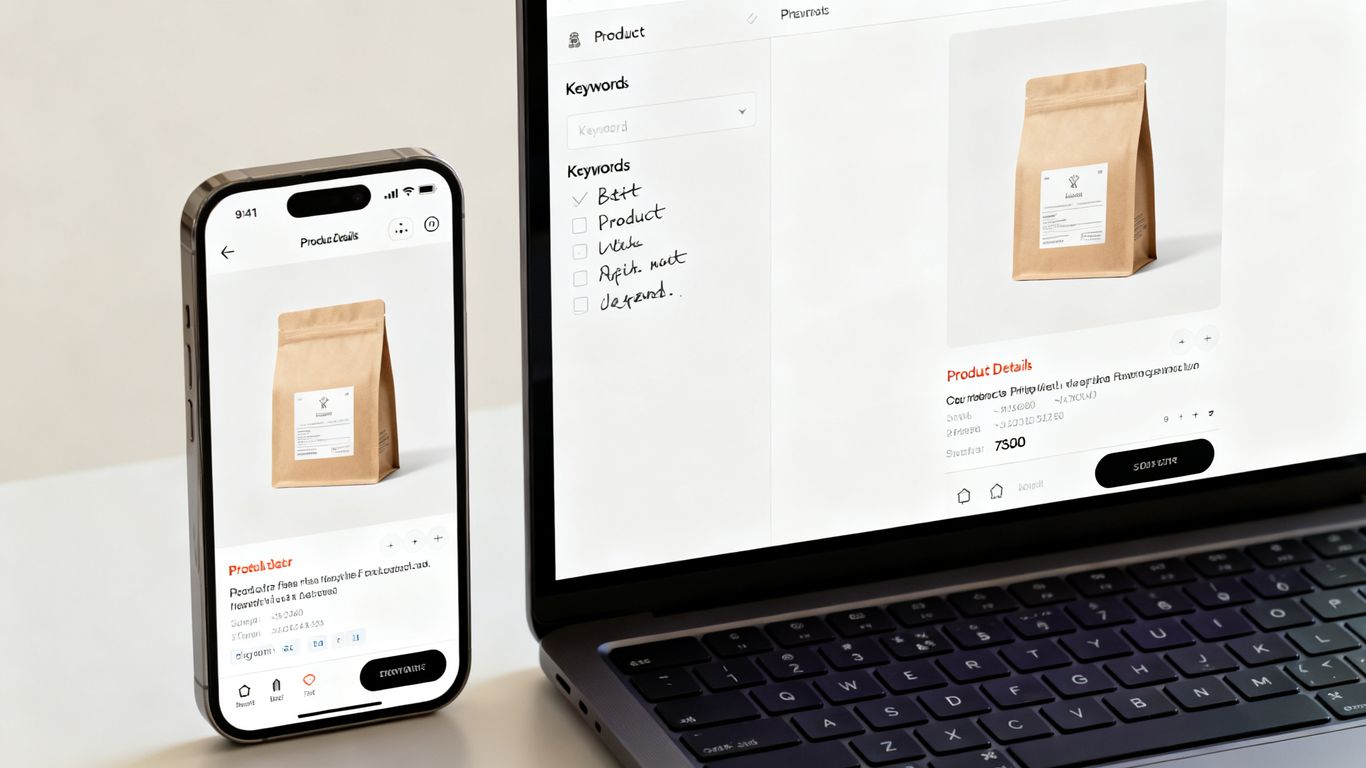
Map primary and secondary keywords to listing elements
Start with a small hierarchy. The primary term should describe the product and its central use, while secondary terms can capture material, size, audience, application, or compatible context when they are genuinely accurate. Group related phrases by intent so the page reflects how shoppers think rather than repeating near-identical wording.
Use search data, customer language, and product knowledge together. The keyword research process should help identify commercially relevant terms, but relevance remains the filter: a popular phrase that describes a different product can bring impressions without useful sales. Assign each worthwhile term to the field where it reads most naturally.
Write titles that balance relevance, clarity, and character limits
A title should let a shopper identify the product quickly. Put the essential product type and distinguishing details near the front, then add attributes that help qualified buyers choose. Follow the applicable category requirements and character limits, and read the title aloud on a phone; awkward repetition becomes obvious when the line is heard as a sentence.
Do not make the title carry every selling point. If it becomes crowded with claims, synonyms, and specifications, the shopper must work too hard to understand the offer. A concise title can still be search-informed when the product identity and strongest differentiators are clear.
Use bullet points to answer buyer questions and overcome objections
Bullets are most useful when each one handles a decision point. Explain a benefit, support it with a relevant product detail, and clarify any condition that affects use. Rather than listing five disconnected features, build a sequence that answers the questions a cautious buyer is likely to ask.
A strong bullet set often covers:
- What the product does and who it suits.
- How it is used, installed, cleaned, or maintained.
- Which size, quantity, material, or compatibility details matter.
- What is included and what the customer must provide.
After drafting, remove repetition and test the bullets against actual questions from reviews and customer service. If a buyer could still misunderstand the product after reading them, the copy needs more precision rather than more keywords.
Place backend search terms and attributes without keyword stuffing
Backend fields are useful for relevant terms that would make the visible copy clumsy, including alternate phrasing and search language that accurately describes the product. They are not a place to add competitor names, unsupported claims, or unrelated traffic. Complete structured attributes carefully as well, since they can help shoppers filter and compare products.
Review the final field set for duplicates, misspellings, and terms that no longer match the product. Visible content should remain easy to read, while backend content quietly broadens accurate discoverability. The two layers should support one another, not tell conflicting stories.
Improve conversion with stronger product communication
Conversion improves when the detail page removes uncertainty at the moment it appears. Shoppers want to know what the product looks like, how large it is, whether it fits their situation, and whether its benefits justify the price. Content should answer those questions in sequence, with each asset doing a distinct job.
Match images to the customer’s decision-making process
The main image earns attention and must make the product recognizable at a glance. Supporting images can then clarify use, dimensions, components, texture, compatibility, and important limitations. Think of the gallery as a short explanation: identification first, proof and context next, reassurance near the end.
Image order matters because many shoppers will not inspect every asset. Keep the visual system consistent, legible on mobile, and faithful to the physical product. For more ideas on connecting images, copy, and A+ Content to conversion, review this conversion improvement guide.
Show product scale, use cases, and differentiating features
A product photographed without context can look appealing yet remain difficult to evaluate. Include a credible sense of scale, show the product in a relevant setting, and make meaningful differences visible rather than relying on broad adjectives. If an accessory, measurement, or installation step affects the purchase, give it an appropriate place in the gallery.
The best visual claims are concrete. A close-up can show construction; a lifestyle scene can show use; a comparison can clarify what is included. Avoid visual promises the product cannot reliably fulfill, since an image that wins the click but creates disappointment can increase returns and poor reviews.
Use A+ Content to explain benefits that bullets cannot cover
A+ Content can provide room for a more considered explanation of the product, especially when the purchase requires education or comparison. Use it to connect a customer problem with the product’s solution, explain a process, and organize supporting details that would overload the bullets. It should add understanding rather than repeat the same sentences in a larger format.
Plan the modules around the questions that remain after the shopper has read the title, bullets, and gallery. Keep the hierarchy simple, use readable text, and make sure the page still works for someone scanning quickly. A+ Content is strongest when it helps a buyer decide, not when it merely fills available space.
Align claims with customer expectations, policies, and product proof
Every promise on the page should be traceable to the product, its documentation, or reliable evidence. Be exact with dimensions, materials, compatibility, performance language, certifications, and guarantees. Claims that sound impressive but lack proof create both policy risk and a mismatch between expectation and experience.
Read the page alongside recent reviews and returns. If customers repeatedly interpret a phrase differently from its intended meaning, rewrite it. Clear qualification is not weak selling; it is a way to attract buyers who are more likely to be satisfied.
Test listing improvements without disrupting growth
Optimization becomes dependable when changes are treated as experiments rather than permanent opinions. A test needs a baseline, a defined question, and a reasonable observation period. The aim is not to force a win from every edit but to learn which communication choices improve the economics of the ASIN.

Establish a baseline before changing titles, images, or bullets
Capture the relevant performance period and note external conditions before publishing a change. Seasonality, promotions, price shifts, stock interruptions, campaign restructuring, and review changes can all affect the result. Record the current version of the content so the team can identify exactly what changed.
Choose the metric that matches the hypothesis. If the question is whether the main image earns more qualified attention, CTR matters first. If the question is whether clearer bullets remove hesitation, CVR, returns, and sales quality deserve more weight than clicks alone.
Test one meaningful variable at a time
Changing the title, main image, bullets, and price together may produce a different outcome, but it will not tell you why. Isolate one meaningful variable when the traffic volume allows it. For larger changes, use a staged rollout or a defined before-and-after comparison with documented caveats.
The variable should be meaningful enough to affect the customer decision. Tiny punctuation edits rarely justify a formal test, while a new positioning statement or image sequence may. Keep the test window long enough to gather useful evidence, without ignoring a clear policy or customer-risk problem.
Interpret CTR, CVR, sales, and organic ranking together
No single metric tells the whole story. A higher CTR with lower CVR may indicate that the new message attracts less-qualified shoppers, while a stable CTR with higher CVR may show that the page is doing a better job after the click. Sales, advertising efficiency, organic visibility, and margin help determine whether the change improved the business rather than one stage of the funnel.
Compare like with like and annotate unusual events. Organic ranking can move slowly, and paid traffic may change the mix of shoppers reaching the page. Use conversion rate testing as part of a broader measurement routine, not as permission to chase one isolated percentage.
Protect winning traffic sources during major experiments
Major listing changes can affect the performance of ads, branded searches, and organic terms that were already working. Before publishing, identify the traffic sources that matter most and decide what would trigger a rollback. Keep campaign structure and bid changes separate when possible so the content test remains interpretable.
If the new version weakens a profitable source, restore the last reliable version and diagnose the result. A controlled rollback is not failure; it protects cash flow while preserving the lesson from the experiment. The same principle applies to inventory: do not stimulate demand you cannot fulfill.
Use tools and automation to make optimization more efficient
Tools help when they reduce manual handling and improve decision quality. They do not replace product knowledge, commercial judgment, or policy review. The most useful workflow gives the team one dependable view of performance and makes routine checks easy to repeat.
Centralize keyword, competitor, and performance data
Bring search terms, listing versions, traffic metrics, conversion metrics, advertising results, reviews, and inventory context into a shared working record. Competitor observation can reveal common customer expectations and gaps in category communication, but it should inform questions rather than encourage imitation. Keep source dates and definitions visible so older data is not mistaken for current evidence.
A central record also improves handoffs. Writers, media specialists, operations teams, and account managers can see the same hypothesis and understand why a change was made. For a publisher such as Blue Amber Digital, whose documented services include Amazon PPC management, product launch strategies, listing optimization, and account management, that kind of cross-functional context is particularly relevant to the broader workflow.
Automate repetitive audits and content quality checks
Automate checks that are rule-based and easy to verify: missing fields, repeated terms, title length, variation inconsistencies, broken image references, stale versions, and unexplained metric gaps. Create alerts for issues that require human review rather than pretending an automated pass proves the listing is correct.
The result should be less administrative work, not less accountability. A person still needs to decide whether the wording is accurate, whether a claim is supported, and whether a proposed change fits the product’s positioning and economics.
Use AI for ideation while preserving brand accuracy and compliance
AI can help organize review language, suggest alternative phrasing, cluster related search terms, or produce first-draft ideas. Treat every output as an input to review. Product specifications, regulatory language, compatibility, guarantees, and performance claims need a source-based check before they reach a customer-facing field.
A useful prompt includes the product facts, prohibited claims, audience, tone, and required constraints. A useful approval process then asks a human to verify every material statement. Speed is valuable only when it does not create correction work, policy exposure, or customer confusion.
Create reusable templates for variations and product families
Templates make consistency easier across related ASINs, but they should define decision rules rather than force identical copy. Separate stable elements, such as brand conventions and image requirements, from variable elements, such as size, compatibility, flavor, or use case. This keeps the catalog coherent while allowing each child variation to answer its own buying questions.
Maintain a source-of-truth document for specifications and approved claims. When a product family changes, update the relevant template and audit affected listings instead of relying on memory. Reuse should reduce errors, not spread them faster.
Build an ongoing Amazon listing optimization system
A listing is not finished when its fields are populated. Customer language changes, competitors reposition, products evolve, and performance shifts with price, stock, seasonality, and advertising. A sustainable system gives optimization a regular place in the operating rhythm without turning every metric movement into an emergency.
Set review cycles based on product maturity and sales velocity
New launches need close observation because the team is still learning which searches and objections matter. Mature, high-velocity products may justify frequent KPI reviews but less frequent major content changes. Low-velocity products can use longer review windows, provided the team still watches for policy, stock, and customer-experience issues.
Set different cadences for monitoring and editing. Metrics may be checked weekly while a substantial rewrite is reviewed monthly or quarterly. The right cadence protects the business from both neglect and constant unmeasured tinkering.
Monitor customer language from reviews, questions, and returns
Customer language often reveals the gap between what a brand intends to communicate and what shoppers actually understand. Group recurring phrases into themes such as fit, setup, durability, packaging, compatibility, or expected result. Then decide whether the answer belongs in the listing, product design, packaging, customer support, or all four.
Reviews and returns should not be mined only for positive words. Negative patterns can identify a misleading image, an omitted measurement, or a use case the product does not support. Feed those findings back into the next content and product decisions.
Connect listing updates with inventory, pricing, and PPC decisions
Content changes alter the context in which traffic converts, so they should be visible to the teams managing bids, budgets, prices, and supply. A stronger page may increase demand; a stock constraint may make that undesirable. Likewise, an ad campaign can expose a high-intent query that deserves a place in the listing after its relevance is confirmed.
Review the detail page as part of the whole commercial system. A profitable Amazon operating model connects listing quality with advertising efficiency, inventory planning, fulfillment, and break-even economics rather than assigning each function a separate target.
Document changes, results, and next actions for continuous improvement
Keep a change log with the ASIN, date, previous content, new content, reason for the change, hypothesis, traffic conditions, results, and next action. Include what did not work. Failed tests are useful when they prevent the team from repeating an attractive but unprofitable idea.
Over time, the log becomes more than an archive. It shows which types of evidence lead to durable gains, which products need deeper work, and where operational constraints repeatedly limit performance. That accumulated learning is the foundation of efficient Amazon listing optimization.
Conclusion
Amazon listing optimization is most effective when it protects the entire growth engine: qualified visibility, confident conversion, healthy margin, reliable inventory, and a disciplined testing process. Start with the ASINs where better communication can make a measurable commercial difference, then build a repeatable system that learns from customers and performance rather than chasing constant edits.
Frequently Asked Questions
What is Amazon listing optimization?
Amazon listing optimization is the process of improving a product detail page’s search relevance, clarity, persuasive communication, and customer experience while monitoring its effect on sales and profitability.
Which listing element should be optimized first?
Start with the element most closely connected to the diagnosed problem. A weak main image may affect CTR, while unclear bullets or missing proof may affect CVR, so the data should guide the first change.
How often should an Amazon listing be updated?
Review frequency should reflect product maturity, sales velocity, seasonality, and the size of the proposed change. Monitor regularly, but make substantial edits only when there is a clear hypothesis and enough evidence.
Do more keywords always improve a listing?
No. Keywords help when they accurately match the product and shopper intent. Irrelevant or repetitive terms can attract poor-quality traffic and make the visible copy harder to understand.
How can images improve conversion?
Images can clarify what the product is, how large it is, how it is used, what is included, and which features differentiate it. The strongest galleries answer common buying questions in a logical order.
What metrics should be tracked after a listing change?
Track metrics that cover the funnel and the business outcome, including impressions, CTR, sessions, CVR, sales, organic visibility, advertising efficiency, returns, and contribution margin where available.
Can listing optimization compensate for a weak product or offer?
Usually not. Better content can clarify a strong offer, but it cannot reliably solve poor product quality, uncompetitive pricing, chronic stockouts, or recurring customer disappointment. Those constraints need their own corrective action.